Arbitrage Trading Strategies: Types, Techniques, and How They Work
Arbitrage trading strategies are widely used in financial markets to identify and potentially profit from price differences between related assets, exchanges, or financial instruments.
These strategies rely on market inefficiencies that cause the same asset, or assets with closely related values, to trade at different prices.
Arbitrage is used across stock markets, foreign exchange, commodities, bonds, derivatives, and cryptocurrency markets. While some strategies involve buying an asset in one market and selling it in another, others use mathematical models, statistical relationships, or differences in exchange rates to identify trading opportunities.
Although arbitrage is often considered a lower-risk trading approach compared with directional speculation, it is not risk-free. Transaction costs, execution delays, liquidity limitations, and sudden price movements can reduce profits or turn an apparently profitable trade into a loss.
Understanding the different arbitrage trading strategies can help traders evaluate opportunities, manage risks, and make more informed decisions.
What Is Arbitrage Trading?
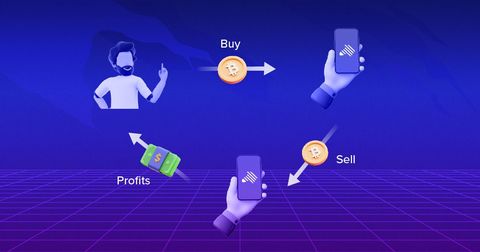
Arbitrage trading is a strategy that attempts to profit from price discrepancies between identical or related financial instruments. The objective is to buy an asset at a lower price in one market and sell it at a higher price in another, or execute related transactions that benefit from temporary pricing differences.
For example, suppose a stock is trading at $100 on one exchange and $101 on another. A trader may purchase the stock at $100 and sell it at $101, potentially earning a $1 gross profit per share before transaction costs and other expenses.
In practice, these opportunities may disappear quickly as other traders and automated systems respond to the price difference.
Arbitrage trading generally depends on three factors:
A measurable price discrepancy between markets or related instruments.
The ability to execute the required trades at suitable prices.
Transaction costs that are low enough to leave a potential net profit.
The more efficiently financial markets operate, the fewer straightforward arbitrage opportunities tend to remain available.
How Arbitrage Trading Strategies Work
Arbitrage strategies follow different processes depending on the market and the type of opportunity being targeted. However, most involve identifying a pricing inconsistency, evaluating its profitability, executing the trades, and managing the resulting positions.
1. Identify a Pricing Inefficiency
The first step is to identify a price difference between two markets, securities, or related instruments.
Traders may compare stock prices across exchanges, currency exchange rates, futures and spot prices, or the historical relationships between financial assets.
Market data platforms and automated scanning tools can help identify discrepancies that may be difficult to detect manually.
2. Calculate the Potential Profit
A visible price difference does not automatically represent a profitable opportunity. Traders must account for brokerage fees, exchange charges, bid-ask spreads, funding costs, taxes, and potential slippage.
The basic calculation is:
Net Profit = Selling Proceeds − Purchase Cost − Total Trading Costs
For example, if a trader buys an asset for $100 and sells it for $101, the gross profit is $1 per unit. If the combined trading costs are $0.30 per unit, the potential net profit is $0.70, assuming both transactions execute at the expected prices.
3. Execute the Trades
Once the opportunity meets the trader's profitability requirements, the necessary transactions are executed.
Some strategies require buying and selling almost simultaneously to limit exposure to changing prices. Others involve holding positions until a pricing relationship returns toward its expected level.
Execution speed and order quality can significantly influence the outcome.
4. Monitor and Manage Risk
After execution, traders must monitor open positions, market conditions, liquidity, and any remaining exposure.
Even when a strategy is designed to reduce directional market risk, unexpected price movements, failed transactions, or changes in market relationships can create losses.
Major Types of Arbitrage Trading Strategies
Different arbitrage trading strategies target different market inefficiencies. The most appropriate approach depends on the trader's capital, technology, market access, and risk tolerance.
1. Spatial Arbitrage
Spatial arbitrage involves buying an asset in one market and selling the same asset in another market at a higher price.
For example, a commodity may trade at different prices across two locations because of differences in local supply, demand, transportation costs, or market access.
A trader may attempt to profit by purchasing the commodity where it is cheaper and selling it where the price is higher.
Spatial arbitrage is also relevant to digital assets traded across cryptocurrency exchanges. However, withdrawal restrictions, transfer delays, exchange fees, and price movements can reduce or eliminate the potential profit.
2. Triangular Arbitrage
Triangular arbitrage is commonly associated with foreign exchange markets. It involves trading between three currencies to exploit inconsistencies in their exchange rates.
For example, a trader may exchange US dollars for euros, euros for British pounds, and British pounds back into US dollars.
If the combined exchange rates produce more dollars than the trader initially held, a potential arbitrage opportunity exists.
However, the exchange rates must be evaluated after accounting for bid-ask spreads, trading fees, and execution costs. In competitive foreign exchange markets, triangular arbitrage opportunities can disappear extremely quickly.
3. Statistical Arbitrage
Statistical arbitrage uses quantitative models and historical data to identify pricing relationships that may temporarily deviate from their expected patterns.
One common approach is pairs trading, in which a trader identifies two historically related securities. When their price relationship moves away from its expected range, the trader may take offsetting positions in anticipation of a reversal.
For example, two companies operating in the same industry may have historically exhibited similar price movements. If their relationship diverges, a statistical model may indicate a potential trading opportunity.
However, historical relationships do not always persist. Changes in company fundamentals, market conditions, or investor behavior can cause a relationship to break down.
Statistical arbitrage therefore requires careful model development, testing, and ongoing monitoring.
4. Cash-and-Carry Arbitrage
Cash-and-carry arbitrage involves taking positions in an asset and a related futures contract when their prices differ from the relationship implied by financing, storage, and other carrying costs.
In a simplified example, if a futures contract is priced substantially above the cost-adjusted spot price of an asset, a trader may buy the underlying asset and sell the futures contract.
The strategy seeks to benefit as the futures contract approaches expiration and the price relationship converges.
However, the apparent difference must be large enough to cover financing expenses, storage costs where applicable, transaction fees, margin requirements, and other risks.
Cash-and-carry strategies are used in markets such as commodities, equity indexes, and cryptocurrencies.
5. Merger Arbitrage
Merger arbitrage focuses on price differences that arise when one company announces an acquisition or merger involving another company.
In a typical cash acquisition, the target company's shares may trade below the announced purchase price because the transaction has not yet closed.
A trader may buy the target company's shares in anticipation of the deal completing and the price moving toward the acquisition value.
The difference between the purchase price and the expected acquisition payment represents the potential gross return.
However, if the deal is delayed, renegotiated, or cancelled, the target company's share price may fall significantly. Merger arbitrage therefore involves substantial deal-related risk and is not a guaranteed-profit strategy.
6. Cryptocurrency Arbitrage
Cryptocurrency arbitrage attempts to profit from price differences between digital asset markets, trading pairs, or exchanges.
For example, Bitcoin might temporarily trade at different prices on two exchanges. A trader may seek to buy it on the lower-priced exchange and sell it on the higher-priced exchange.
Common approaches include cross-exchange arbitrage, triangular arbitrage within an exchange, and strategies involving spot and futures markets.
Cryptocurrency markets can present pricing discrepancies because exchanges operate independently and liquidity varies across trading platforms.
However, traders must consider withdrawal fees, network congestion, exchange reliability, liquidity, regulatory requirements, and the risk of sudden price changes. Exchange insolvency and custody risks can also be important considerations.
Benefits of Arbitrage Trading Strategies
Arbitrage trading offers several potential advantages when implemented carefully.
Opportunities Across Multiple Markets
Arbitrage is not limited to one asset class. Traders can explore opportunities in equities, currencies, commodities, derivatives, and digital assets.
This flexibility allows strategies to be tailored to different market structures and trading conditions.
Reduced Dependence on Market Direction
Some arbitrage strategies use offsetting positions designed to reduce exposure to broad market movements.
For example, a market-neutral statistical arbitrage strategy may involve buying one security while selling another.
Nevertheless, offsetting positions do not eliminate all risk. Correlations can change, hedges can become ineffective, and execution costs can affect performance.
Potential for Systematic Trading
Many arbitrage strategies can be translated into quantitative rules and automated trading systems.
Automation can help monitor multiple markets, calculate price differences, and execute trades when predefined conditions are met.
However, automated systems require reliable data, appropriate testing, monitoring, and safeguards against execution errors.
Disciplined Decision-Making
Arbitrage strategies often use predefined entry criteria, profitability thresholds, and risk limits.
This systematic approach can reduce reliance on emotional decisions, although the quality of the strategy still depends on its assumptions and implementation.
Risks and Challenges of Arbitrage Trading
Despite its potential benefits, arbitrage trading involves several practical challenges.
Transaction Costs
Brokerage fees, exchange charges, bid-ask spreads, financing expenses, and taxes can consume much of the expected profit.
A price difference that appears attractive before costs may become unprofitable after all expenses are included.
Execution Risk
A strategy may require multiple orders to execute at nearly the same time. If one order fills and another does not, the trader may be left with an unwanted market position.
This risk becomes particularly important during periods of high volatility or low liquidity.
Liquidity Constraints
Some assets have limited trading volume or shallow order books. Large orders can move prices and make it difficult to enter or exit positions at the expected price.
As a result, an opportunity that works for a small trade may not remain profitable at a larger scale.
Technology and Data Risks
Automated arbitrage depends on accurate market data, stable connectivity, and reliable order execution.
Delayed price feeds, software errors, exchange outages, or incorrect calculations can lead to unexpected losses.
Model Risk
Statistical arbitrage and other quantitative strategies rely on assumptions about market behavior.
If those assumptions are incorrect or market conditions change, a model may generate misleading signals or fail to perform as expected.
How to Get Started With Arbitrage Trading
Beginners should approach arbitrage trading systematically rather than assuming that every price difference represents a profitable opportunity.
Step 1: Choose a Market
Start with a market you understand, such as equities, foreign exchange, futures, or cryptocurrency.
Each market has different trading hours, fee structures, liquidity conditions, and regulatory requirements.
Step 2: Select a Suitable Strategy
Learn how a specific strategy works before committing capital. Simple price comparisons may be easier to understand, while statistical and algorithmic strategies generally require stronger analytical and technical skills.
Step 3: Understand All Trading Costs
Calculate the expected net return after commissions, spreads, financing, transfer fees, and other relevant expenses.
Do not evaluate an opportunity using quoted prices alone.
Step 4: Test the Strategy
Use historical data, simulations, or paper trading to evaluate how the strategy performs under different market conditions.
Testing should account for realistic transaction costs, execution delays, and the possibility that a trade cannot be completed as planned.
Historical results do not guarantee future profitability.
Step 5: Apply Risk Controls
Set limits for position sizes, total exposure, acceptable losses, and operational failures.
For strategies involving multiple exchanges or instruments, establish procedures for handling partial fills, trading interruptions, and failed transfers.
Step 6: Review Performance Regularly
Track realized returns, transaction costs, execution quality, and risk exposure.
A strategy that worked under earlier market conditions may become less effective as competition increases or pricing relationships change.
The Role of Technology in Arbitrage Trading
Technology has become an important part of modern arbitrage trading. Professional firms often use algorithms to analyze market data, detect price discrepancies, calculate expected returns, and submit orders automatically.
High-frequency trading systems may process market information in milliseconds or less, depending on the infrastructure and market.
Machine learning and advanced analytics can also help traders study pricing relationships, estimate transaction costs, and identify unusual market behavior.
However, sophisticated technology does not guarantee profits. Competitive advantages can be expensive to develop, and poorly designed systems may amplify losses instead of preventing them.
For individual traders, the most practical starting point is often a transparent strategy with understandable assumptions, reliable data, realistic cost estimates, and clearly defined risk limits.
Arbitrage Trading vs. Traditional Speculative Trading
Arbitrage trading and speculative trading differ mainly in how they seek returns.
Arbitrage focuses on pricing discrepancies or relationships between assets, while directional speculation attempts to profit from anticipated price movements.
Arbitrage strategies may use offsetting positions to reduce certain types of market exposure. Speculative strategies may instead depend more directly on whether an asset's price rises or falls.
However, the distinction is not absolute. Some strategies described as arbitrage involve significant directional, liquidity, financing, or event-related risks.
The most important consideration is how the strategy generates returns, what assumptions it relies on, and what could cause it to lose money.
Future Trends in Arbitrage Trading
Arbitrage trading is likely to continue evolving as financial markets become more interconnected and technology advances.
Artificial intelligence, machine learning, cloud computing, and improved data infrastructure are expanding the tools available for identifying and analyzing pricing differences.
Digital asset markets may continue to create opportunities as exchange structures, liquidity, and market participation develop. At the same time, increasing competition and improvements in market efficiency can make simple opportunities harder to capture.
Regulatory developments, transaction costs, and access to reliable execution infrastructure will remain important factors in determining which strategies are practical.
The future of arbitrage trading will depend not only on identifying price discrepancies but also on executing trades efficiently, managing operational risks, and adapting to changing market conditions.
Conclusion
Arbitrage trading strategies provide a structured approach to identifying and potentially exploiting price differences across financial markets. From spatial and triangular arbitrage to statistical, cash-and-carry, merger, and cryptocurrency arbitrage, each strategy relies on a different type of pricing inefficiency.
Although arbitrage can reduce dependence on broad market direction in certain situations, it does not eliminate risk. Trading costs, liquidity limitations, execution failures, market volatility, and changing relationships can all affect results.

Related Post...

What Do Investment Bankers Do? A Clear Guide to the Role, Path, and Impact
Updated: October 21, 2026
Read More
AI-Based Financial Forecasting: How Artificial Intelligence Is Transforming Financial Planning
Updated: October 26, 2026
Read More
Accounts Payable Optimization: Strategies, Benefits and Best Practices
Updated: October 26, 2026
Read More